Vibe Coding Beyond the Prototype
What to Consider Before Building a Production Product
Vibe coding has dramatically changed how quickly an idea can become working software.
Describe a feature, refine it through prompts, connect a database, generate an interface, add authentication—and something that might once have required weeks of initial development can begin taking shape in days.
That is powerful.
But after working extensively with vibe coding, I started thinking about a different question:
What happens after the application works?
Building the first version and maintaining a commercial software product are two very different engineering problems.
The more we use AI-assisted development, the more important it becomes to understand where vibe coding creates extraordinary leverage—and where traditional engineering discipline still matters.
1. Vibe coding changes the economics of starting
Early-stage software development contains enormous uncertainty.
Will the workflow make sense?
Does the idea solve the problem?
What should the data model look like?
How should users move between screens?
Do we even need this feature?
This is where vibe coding can be remarkably effective.
Instead of spending significant engineering time implementing an idea before anyone can interact with it, teams can rapidly create a working version, test assumptions and change direction.
In other words, vibe coding can compress:
Idea → Prototype → Validation
And that has real business value.
The interesting part begins when the prototype survives.
Now the question is no longer:
Can we build it?
It becomes:
Can we keep changing it safely?
2. The economics change as the product becomes more complex
A small application may allow an AI coding platform to make broad changes successfully.
A mature application is different.
Changing what appears to be one feature may affect:
database relationships
APIs
authentication
authorization
tenant isolation
UI state
existing workflows
integrations
automated tests
reporting
performance
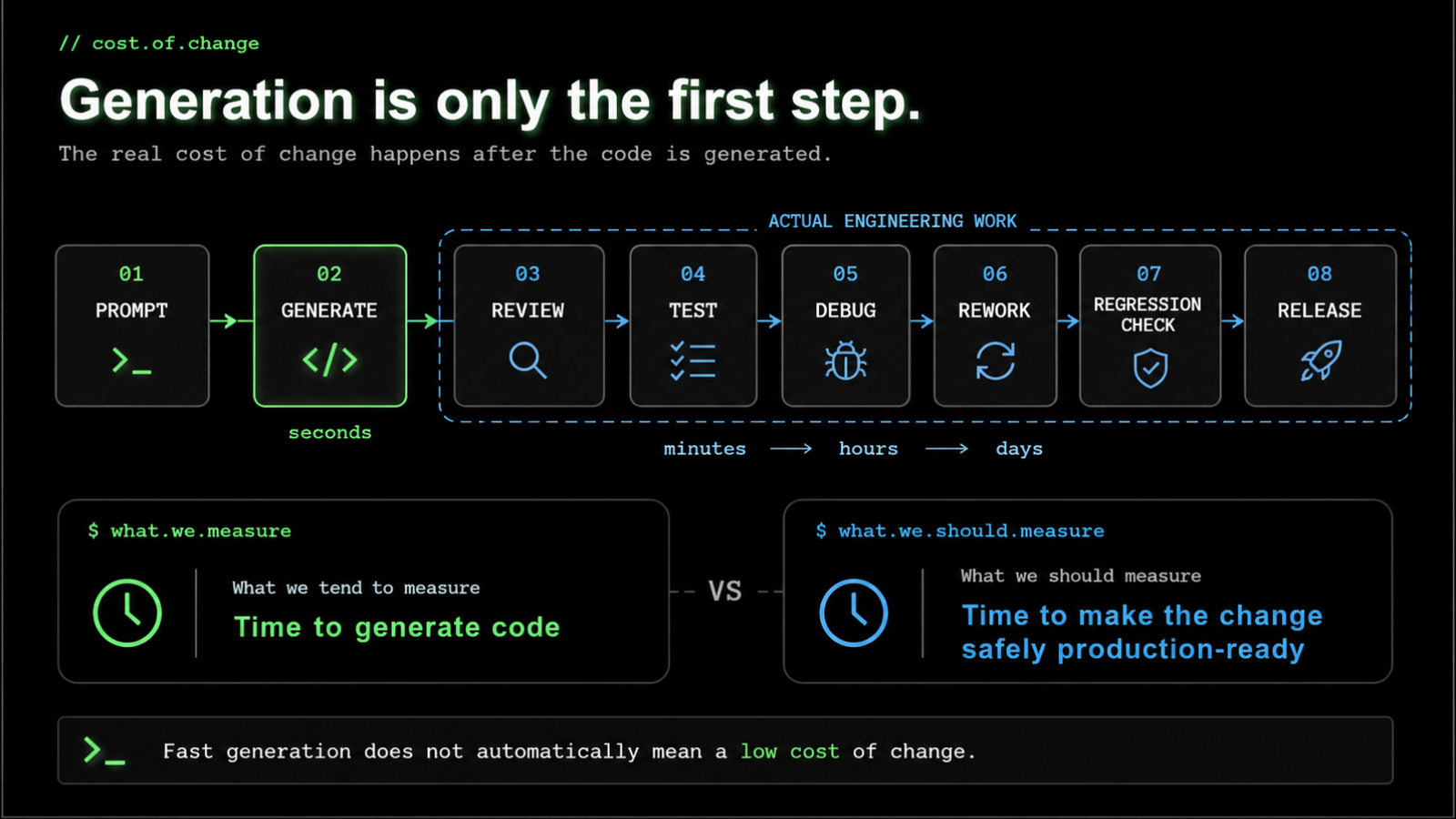
At that point, development cost should not be measured simply by how quickly code is generated.
A more realistic equation is:
Development cost = Generation + Review + Testing + Debugging + Rework + Regression Risk
This is where teams should begin measuring something that receives much less attention than initial development speed:
the cost of change.
If a developer can understand the architecture and make a controlled modification locally in an hour, while an AI-assisted workflow requires several prompt-and-test cycles to reach the same predictable result, the faster-looking development method may no longer be the faster one.
That doesn't mean the AI tool has failed.
It means the product has entered a different stage of its lifecycle.
3. Who understands the architecture?
Suppose AI helps generate 40,000 lines of functioning code.
The application works.
Six months later, another developer needs to modify it.
Can the team explain:
why the architecture was designed that way?
where critical business rules live?
whether logic has been duplicated?
how authorization is enforced?
which components are tightly coupled?
how database queries behave at scale?
what might break if a particular service changes?
Generated code is not automatically poor-quality code.
But code that an organization owns without adequately understanding becomes a risk, regardless of whether it was written by AI or a human.
This makes architectural documentation, code review and engineering ownership even more important in AI-assisted development—not less.
AI can generate implementation.
The organization still needs to own the architecture.
4. "It works" is not a security assessment
This becomes particularly important when the application handles financial, healthcare, educational, customer or other sensitive information.
A successful login tells us that authentication works.
It doesn't tell us whether User A can manipulate an API request and retrieve User B's records.
A successful multi-tenant application doesn't automatically prove that Tenant A can never access Tenant B's data.
A successful file upload doesn't tell us whether malicious files can be uploaded.
Before commercial deployment, AI-generated applications should undergo the same security scrutiny expected from conventionally developed software.
That includes areas such as:
Authentication and authorization
Permissions should be enforced at the appropriate backend/data layer—not merely by hiding buttons in the interface.
Tenant and data isolation
Multi-tenant SaaS applications need strong controls ensuring one organization's data cannot become accessible to another.
Secrets management
API keys, database credentials and tokens should not live in generated source code or be casually exposed through prompts.
Input and output validation
User input, uploaded files, API parameters and generated outputs need appropriate validation and sanitization.
Dependency management
AI-generated code can introduce libraries and packages that need to be checked for vulnerabilities, maintenance status and suitability.
Logging
Logs should provide enough information for investigation without unintentionally recording credentials, tokens or sensitive user information.
Testing and security validation
Static analysis, dependency scanning, dynamic testing, automated tests, code review and penetration testing remain relevant regardless of who—or what—generated the code.
This isn't simply theoretical guidance. OWASP's current Secure Coding with AI guidance specifically warns about issues such as hallucinated or outdated dependencies, prompt-to-code supply-chain risk, context leakage and overreliance on AI review. It also explicitly keeps human accountability in the loop.
NIST's Secure Software Development Framework makes the broader point: secure development practices need to be integrated throughout the software development lifecycle to reduce vulnerabilities and their impact. AI-assisted development doesn't remove that requirement.
5. Your vibe-coding platform is part of your software supply chain
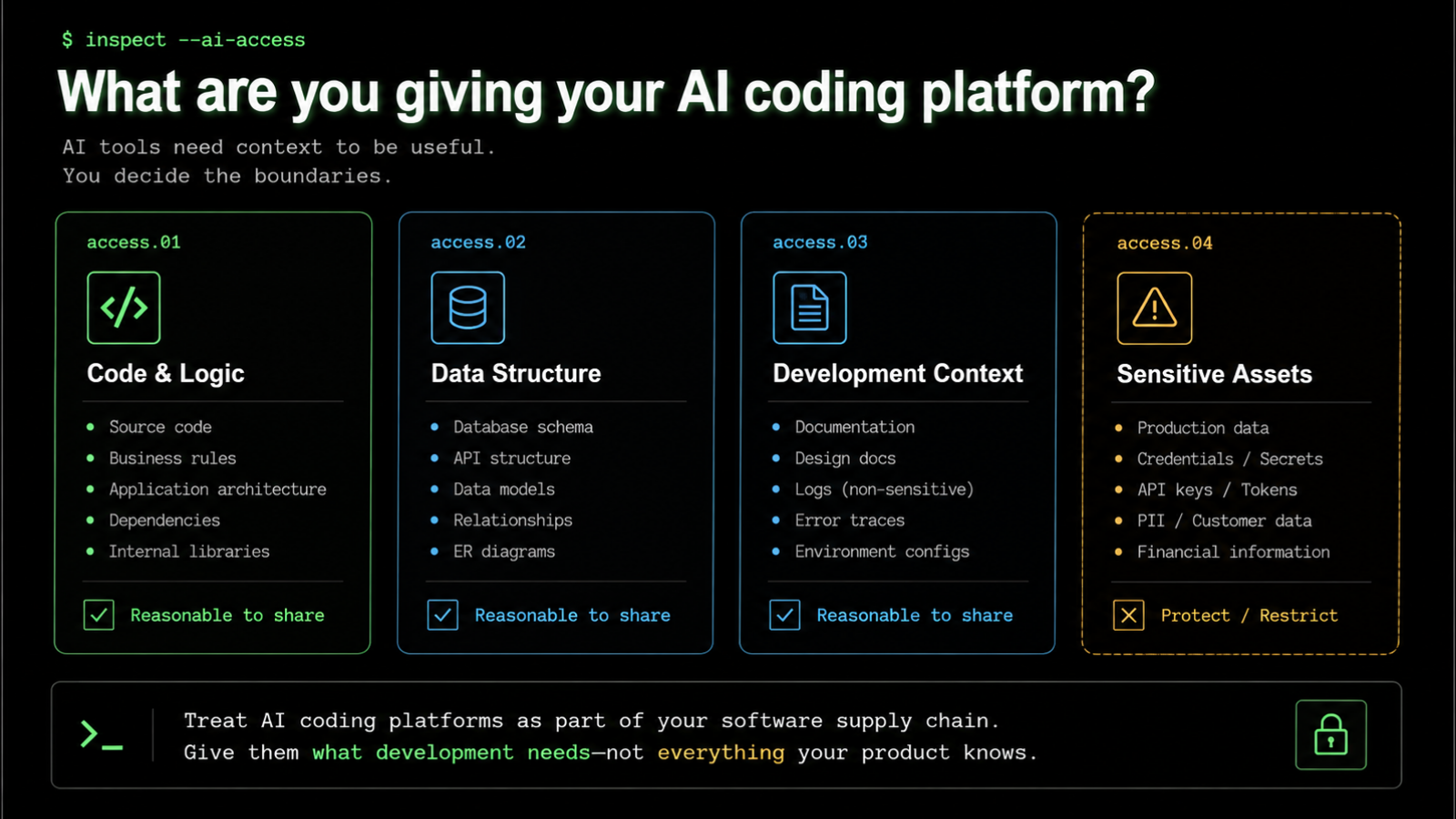
There is another question organizations should ask before giving an AI development platform extensive access to a commercial codebase:
What information are we giving the platform?
Source code can reveal much more than UI functionality.
Depending on what is provided, development context may contain:
proprietary business logic
application architecture
database schemas
API structures
authentication approaches
internal documentation
debugging logs
configuration information
third-party integration details
Organizations should therefore evaluate an AI coding provider similarly to other important technology vendors.
Questions worth asking include:
How long are prompts and code retained?
Can submitted data be used for model training?
What enterprise privacy controls are available?
Which sub-processors may handle the data?
How is data encrypted?
Where is data processed and stored?
What are the provider's IP and confidentiality terms?
Can organizational data be deleted?
What audit capabilities exist?
What happens in the event of a security incident?
This doesn't mean an AI coding provider should automatically be considered unsafe.
It means trust should be evaluated rather than assumed.
OWASP's current GenAI guidance similarly treats supply-chain exposure and sensitive-information disclosure as important categories of AI-related risk.
A sensible engineering principle is therefore:
Give an AI development environment only the information and access it actually needs.
Use test or synthetic data wherever possible.
Keep production credentials out of prompts.
Use proper secrets management.
Separate development and production environments.
Apply least privilege.
For organizations working with regulated or highly sensitive information, those practices become particularly important.
6. When should conventional engineering take more control?
There probably isn't a universal point where a team should announce:
"The MVP is finished. Turn off vibe coding."
AI-assisted development can remain useful throughout the lifecycle.
But there are signals that a product needs increasingly controlled engineering practices.
Watch for situations where:
small changes repeatedly create unrelated regressions
generated solutions become difficult for developers to explain
multiple prompt iterations are required for changes that would be straightforward manually
business logic is becoming increasingly complex
multiple developers need predictable branching and code-review workflows
automated testing becomes critical
performance optimization becomes necessary
the application begins processing sensitive or regulated information
compliance requirements increase
integrations and dependencies multiply
At that point, the question shouldn't be whether AI is allowed to write code.
The question should be:
How much autonomy should AI have within our engineering process?
That is a much more useful distinction.
A hybrid development model may be the real opportunity
The debate around AI development is sometimes framed as:
Vibe coding vs. traditional development.
I increasingly think that's the wrong comparison.
A more practical model might look like:
Explore with AI → Validate quickly → Stabilize architecture → Engineer deliberately → Continue using AI as an accelerator
AI can remain enormously useful for scaffolding, repetitive implementation, test generation, documentation, debugging assistance, refactoring suggestions and rapid experimentation.
But architecture, security boundaries, code ownership, production access and release quality still need deliberate engineering governance.
This aligns with the broader direction of secure-development frameworks: new development methods can change how software is produced without removing the responsibility to systematically manage software risk.
Vibe coding didn't eliminate software engineering. It moved the starting line.
That may ultimately be its biggest contribution.
People who previously needed significant development resources just to test an idea can now reach a functioning prototype remarkably quickly.
Founders can validate concepts earlier.
Product teams can experiment more cheaply.
Developers can automate substantial amounts of repetitive implementation.
Organizations can explore ideas that previously might never have survived the cost of getting started.
That is a meaningful shift.
But the ability to generate software faster doesn't change what production software eventually needs to become:
understandable, maintainable, testable, secure and reliable.
So perhaps the most useful question for teams considering vibe coding isn't:
"Can AI build our application?"
It clearly can build increasingly sophisticated software.
The better question is:
"Which parts of our software lifecycle should AI accelerate, and where does engineering discipline need to take control?"
The teams that answer that well may gain something much more valuable than faster coding.
They may get faster innovation without surrendering engineering quality.